
|
|
Plan beforehand where are you going to stock and assemble the structure.You must always visit the construction site. Who is going to decide what to do? Right from the very start: where are you going to pre-assemble the most elements as possible of the structure at ground level.
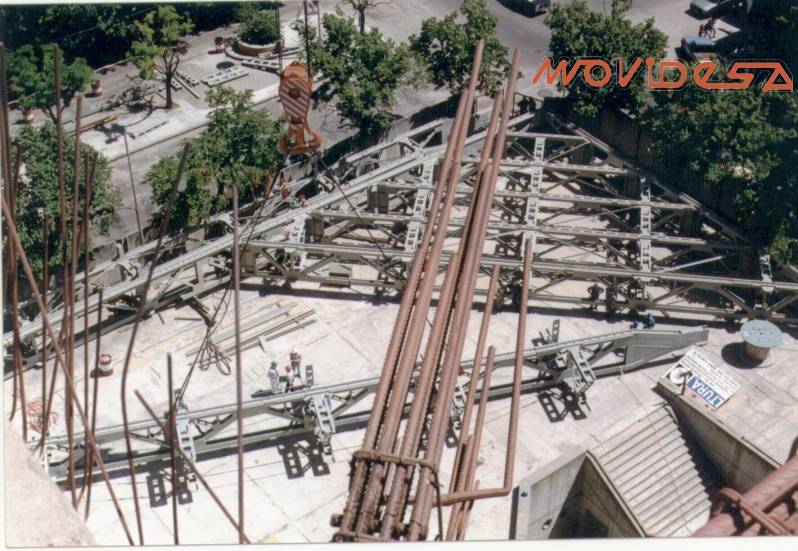
Photo: Teatro Argentino de La PLata, Buenos Aires, Argentina. The triangle -shaped structure on ground level is assembled 180º from its final position due to the very restricted area.(See also Preassembling of structures for the turn-around while lifting this structure).
Another example: only half the street to assemble this bridge.
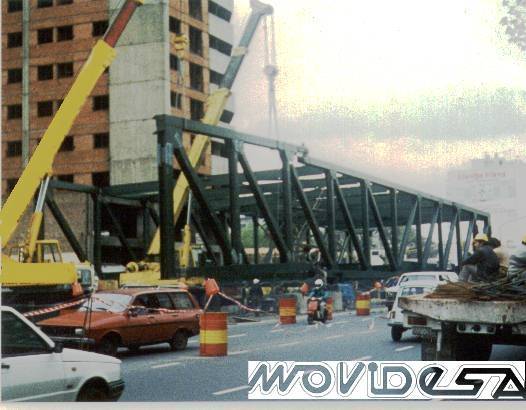
Photo: Av. Maipú bridge - Tren de la Costa. - L=62m W=16,5m H=6,5m
HAVE A DETAILED ERECTION PLAN
If you do not have a detailed gantt, pert or any schedule do not expect the crane operator or the foreman to solve the problems you should resolve before starting to work.
Even more: do not trust on the tranquilizing words of a crane-rental company. You should not let them choose what to do or use and always check the load-charts of the equipment.
A GOOD PLAN SAVES COSTS AND ACCIDENTS
A well-studied erection plan saves more accidents than all the measures that are granted to be taken - like safety belts, helmets, gloves, and so on -
This is because you avoid a whole category of accidents: the risk that is taken when you decide the type of tasks to be done.
For instance, when you decide to pre-assemble a structure at ground-level instead of lift piece by piece and screw them at a heigh level, you avoid a number of accidents that are impossible to calculate, despite the use of a net, guard-life cables, etc.
SAFETY AND HYGIENE AT WORK
You must always follow the regulations in every step of the work. The main safety measures you take have to be in the plans and scheduled. Never improvise on this - if you are not sure about the safety of a particular task, simply do not start with it until you know exactly what to do.
CHECK ALL BEFORE USE
Steel ropes, slings, electrical devices, lifting equipment... all you can imagine that could fail should be checked before using.
You can test your lifting equipment under a certain load by letting it hang from the hook's crane for a while - i.e. an hour - Then check all over the crane and also the ground under the supports of the outrigger beams.
Most important: even the structure you are going to lift needs to be checked. You have to make a stress and geometric analysis of the pieces as they are going to be lifted. A large beam often does not resist local or lateral buckling when lifted alone, so you have to reinforce it.
Also the structure as a whole has to be checked at every step of its construction, by the norms it was designed.